Chinese Carriers Also Face Challenges On Asia-Europe Sector, Despite Flying Over Russian Airspace
 Staff Writer,
15 Apr 2026
2 min read
Staff Writer,
15 Apr 2026
2 min read
Chinese international carriers, theoretically, are well-placed to capitalize on the current market situation, in which Middle Eastern airlines are struggling to serve the Asia-Europe market.
The Chinese airlines have the advantage of flying over Russian airspace, resulting in more direct flight paths and considerably lower fuel burn. Many other carriers – including those from Europe, North America, Japan, Korea, Australia, Singapore, etc. – are banned as a result of Russia’s retaliation for the sanctions the West imposed on Russia for the war with Ukraine.
Besides more direct flight paths, the Chinese airlines have reportedly also been optimizing fuel performance further by flying at even higher altitudes. The higher the altitude, the thinner the air is. This means the engines operate more efficiently, resulting in lower fuel burn.
Despite these savings, fuel still accounts for 30-40% of an airline’s cost base – whether Chinese or not – so Chinese airlines have been very adversely affected by the high fuel prices.
Nearly all the Chinese airlines, unlike some western carriers, have refrained from fuel hedging, resulting in an immediate hit from the fuel price shock.
Chinese carriers have been discounting their flights to Europe, which may give the impression these carriers are seeking to gain market share.
But it is more out of necessity. Chinese carriers are finding it hard to sell seats, because of the poor state of China’s economy.
China’s government has forecast GDP growth this year of 4.5-5%, its lowest since 1991. The country’s export-driven economy is facing strong headwinds from tariffs, economic uncertainty and a slowing global economy.
Chinese carriers need strong outbound Chinese tourism to succeed, but Chinese tourists are largely avoiding Europe and the Middle East, due to geopolitics and a lack of consumer confidence in the economy.
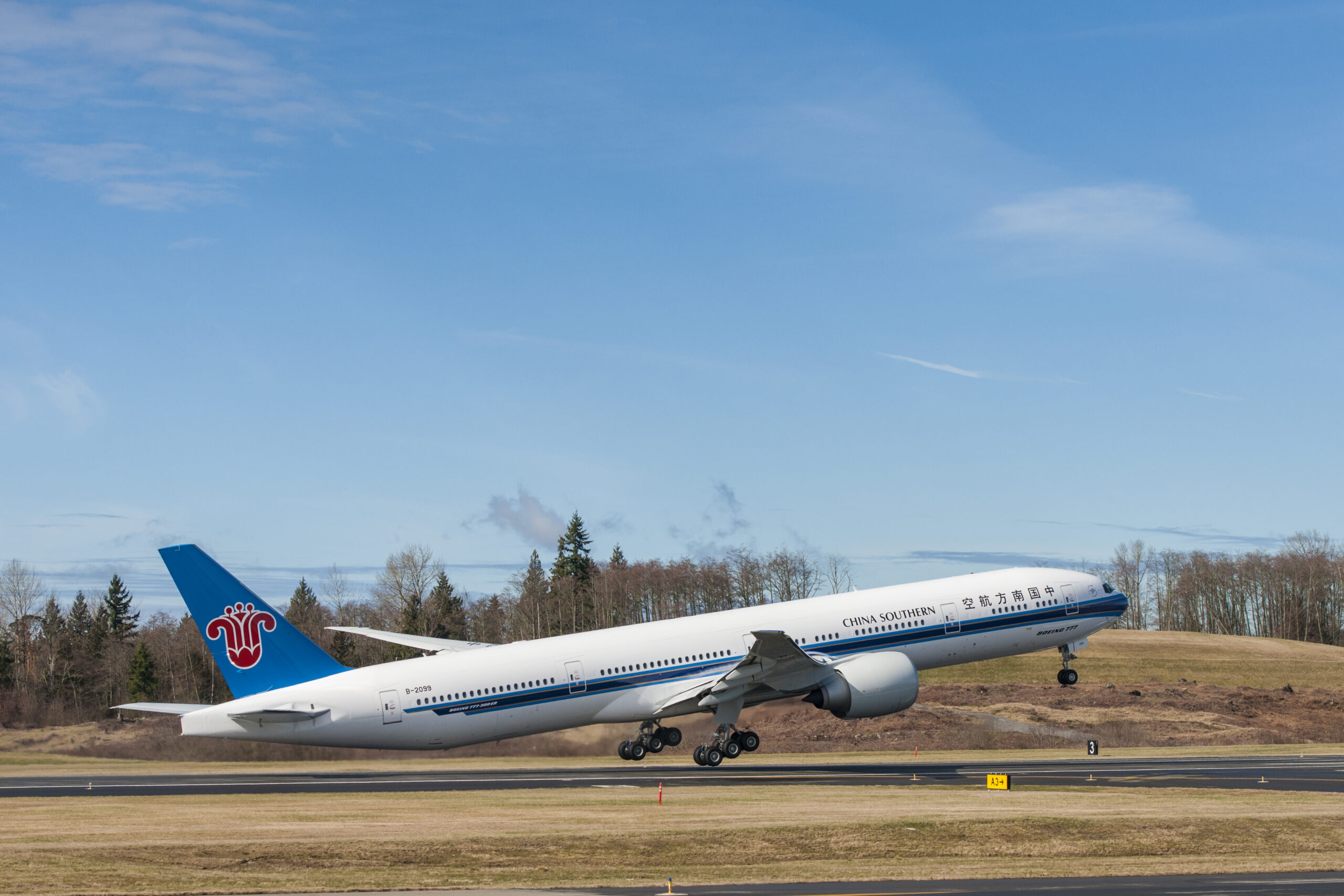
Feature picture, from Boeing, shows a China Southern Airlines Boeing 777-300ER.