Rex Owner Air T Blames Engine Troubles And Fuel Costs For Loss At Saab 340 Operator
 Staff Writer,
16 Nov 2026
2 min read
Air T, the US owner of Australian regional carrier Regional Express (Rex), says unscheduled engine removals and a doubling of fuel costs pushed Rex into a quarterly loss.
Air T says, in a statement to the US Securities and Exchange Commission, that in the three months ending 30 September Rex lost about US$0.9 million at the adjusted earnings before interest, tax, depreciation and amortisation (EBITDA) level, on US$56.8 million of revenue.
It says Rex’s revenue includes passenger, ancillary, freight and charter income and government subsidy income. Rex’s operating loss was US$10 million, after a US$9.4 million charge for depreciation and amortisation.
The company says the quarter was notably challenging due to a combination of unscheduled engine removals, delays at engine overhaul shops and fuel costs doubling since the Iran war started.
Air T says fuel was the main driver of the loss, with the rise coming mainly from higher prices per litre rather than greater fuel consumption. Rex does not hedge fuel or the related Australian dollar/US dollar exposure.
It says it is limiting the cost impact through fare adjustments, capacity management and fuel levy arrangements with certain state governments in Australia.
Air T adds that higher unscheduled engine removals, together with lower engine throughput at third-party maintenance providers, reduced the number of aircraft in operation to below what it had planned.
The Australian Government said last November that it had agreed to provide Rex with a new commercial loan of A$60 million (US$40.5 million) to support Air T’s takeover, in exchange for commitments by Air T that included returning more aircraft to service. The government also restructured Rex’s existing debt to the Australian Government, and said it would retain security over all of Rex’s aircraft and its simulator.
ANALYSIS AND BACKGROUND
Rex’s Saab 340Bs are each powered by two General Electric CT7-9B turboprops. The CT7 is the civil member of GE’s CT7/T700 engine family, whose T700 turboshaft powers military helicopters such as the Black Hawk, Seahawk and Apache.
There are very few shops in the world authorised to overhaul the CT7-9B. StandardAero’s facility in Portsmouth, UK, has GE approval to overhaul the CT7/T700 series engines. The only other GE-authorised CT7-9B overhaul provider is ITP Aero in Albacete, Spain, which GE added to its CT7-9B support network in 2023.
There is no CT7-9B overhaul shop in Asia-Pacific.
Air T said in August that the binding constraint at Rex “continues to be aircraft availability due to unscheduled engine removals and third-party maintenance, repair and overhaul (MRO) turnaround times”.
Australia’s transport minister, Catherine King, said in a statement in July that “supply chain constraints have slowed down Rex’s Engine Care and Maintenance Program, but we continue to monitor progress against agreed commitments.”
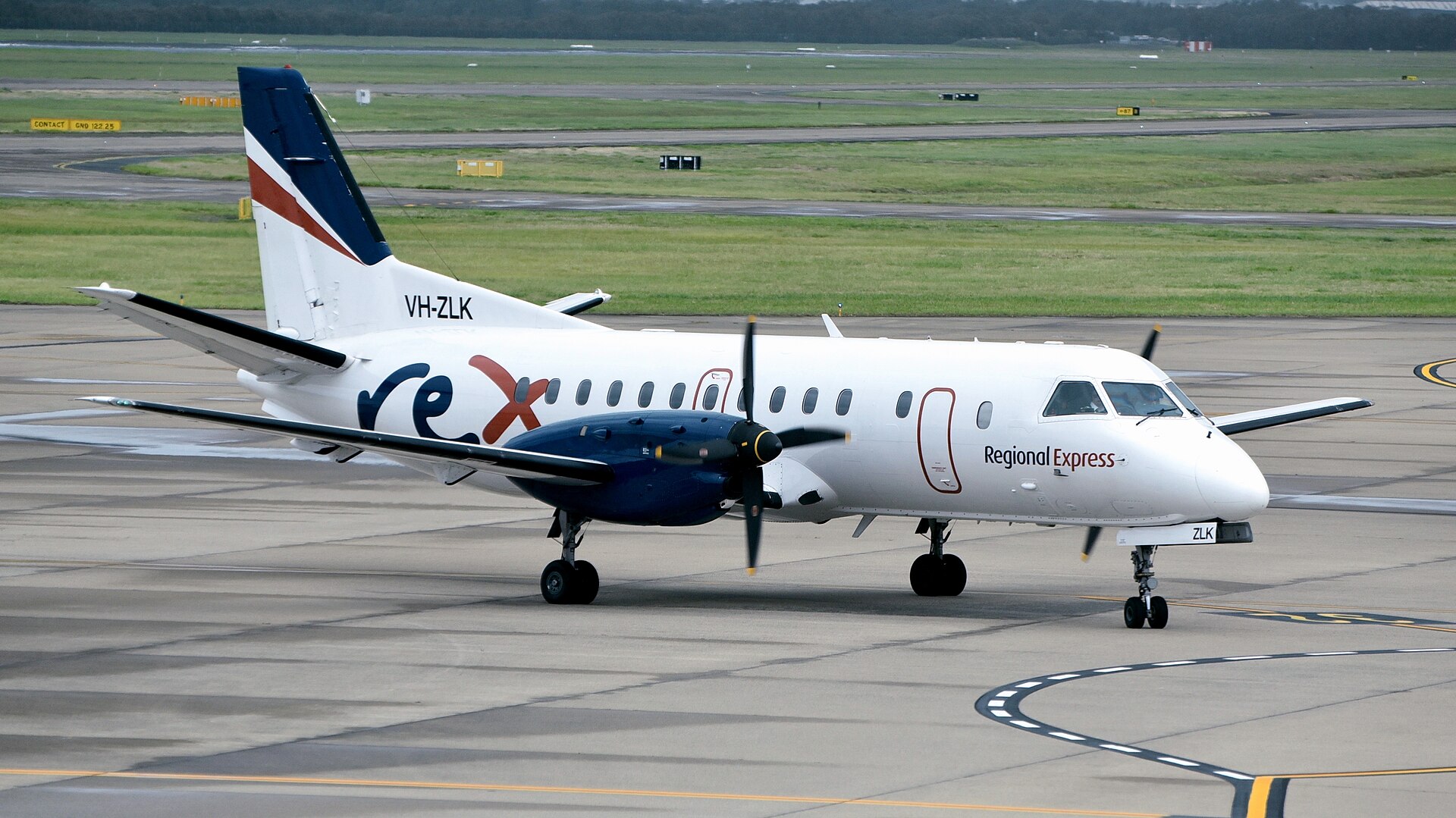
Feature picture shows a Rex Saab 340, VH-ZLK, at Brisbane. Credit: Bahnfrend / Wikimedia
Rex Owner Air T Blames Engine Troubles And Fuel Costs For Loss At Saab 340 Operator