

China’s Comac Completes First Crewed Flight Of All-Electric 19-Seater
 Staff Writer,
15 Nov 2026
4 min read
The Commercial Aircraft Corporation of China (Comac) has completed the first crewed flight of its CE-25A all-electric aircraft, a 19-seat type designed for intercity commercial services.
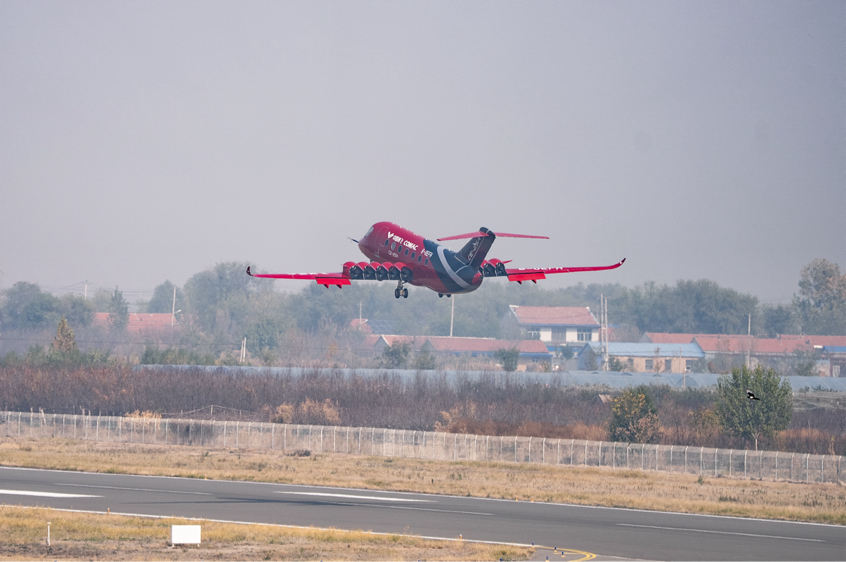
The aircraft flew on 14 November at Binzhou, a city in Shandong province, with two pilots and a flight-test engineer on board.
China’s state-owned media say the all-electric aircraft departed Binzhou Dagao Airport and spent 16 minutes and 38 seconds in the air, covering a distance of 60.4km.
Comac says the aircraft performed normally and all indicators met expectations.
The state-owned media say the crewed sortie follows 19 uncrewed flights of the CE-25A, the first of which took place on 2 February.
Comac developed the CE-25A with Chinese battery maker Contemporary Amperex Technology (CATL), Shanghai Jiao Tong University and other domestic partners.
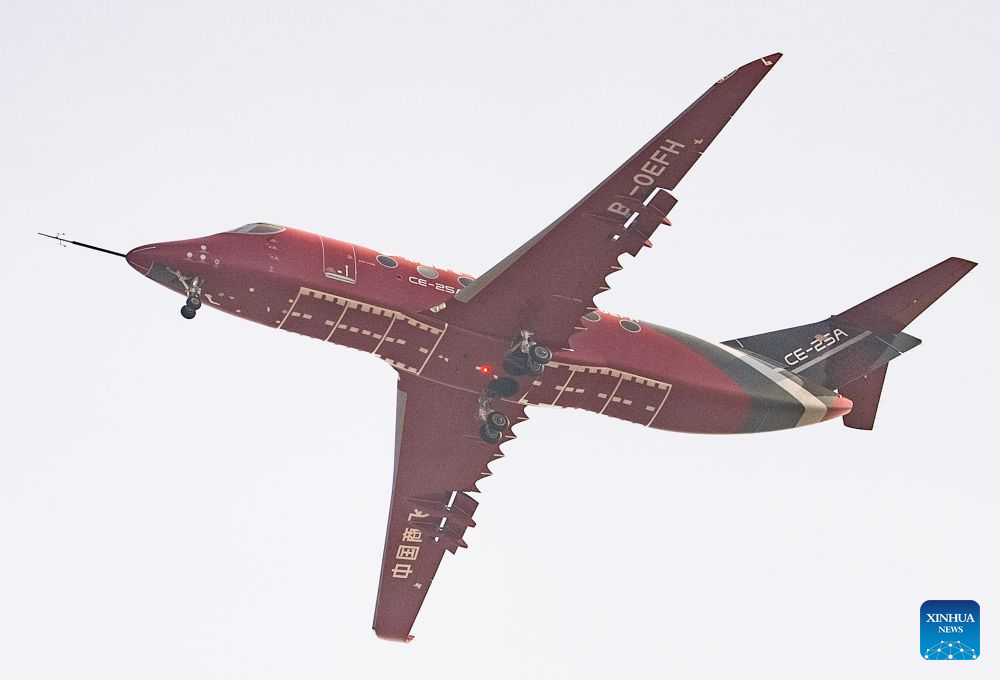
The CE-25A is Comac’s first electric commercial aircraft. Comac says the type is designed mainly for intercity commercial flights and can carry 19 passengers. It has a maximum take-off weight of 10 tonnes, a cruise speed of 300km/h (162kt), a cruise altitude of 7,874ft and a range of 400km (216nm). Comac has not said what payload or reserves that range assumes. The aircraft uses 10 electric ducted fans, five on each wing.
Comac says the designation breaks down as follows: “C” stands for China and Comac; “E” stands for electric; “25” denotes CCAR-25, the Chinese transport-category airworthiness rules that also apply to large commercial aircraft; and “A” marks it as the first product.
The Civil Aviation Administration of China (CAAC) says it has accepted Comac’s application for a type certificate.
Comac first presented the CE-25A as a concept at the China International Import Expo in Shanghai in November 2023.
Comac has not disclosed the cabin seating layout, whether the cabin is pressurized, the battery capacity, the aircraft’s price, a launch customer or an entry-into-service date.
Analysis and background
The CE-25A’s published figures put it in the same 19-seat class as the Dornier 228 NXT, produced by General Atomics AeroTec Solutions, De Havilland Canada’s DHC-6 Twin Otter Series 400 and the passenger version of Textron Aviation’s Cessna SkyCourier.
It seems China is applying the same strategy that it successfully deployed in the automotive industry: leapfrogging the competition with new technology, namely an all-electric version.
The aircraft has a 10-tonne maximum take-off weight (MTOW), which it needs to account for the weight of the batteries. This MTOW is above the 19,000lb (8.62-tonne) cap of the old US commuter category under FAA Part 23, to which the Cessna SkyCourier is certified. The Dornier 228 and Twin Otter are likewise certified to the lighter Part 23 or CS-23 standards used for 19-seat commuter types.
The CE-25A’s range is also likely to be well below the 400km maximum range quoted, because commercial aircraft need reserves to account for flight diversions, and flight routes are never in a perfectly straight line.
If Comac does commercialize the type, the most immediate competitive effect would likely be in China’s domestic short-haul market, where a 400km range covers many intercity sectors. On the longer, thinner or austere routes that sustain the Twin Otter and Dornier 228 in the wider Asia-Pacific, the CE-25A’s range, speed and need for charging make it a much weaker prospect on today’s figures.
That said, a key advantage of all-electric aircraft is lower maintenance costs, as there are no costly engine overhauls, and the electricity used to recharge the batteries can come from renewables such as solar energy. The cost of producing solar energy is now far lower than the cost of fossil fuels.
| Comac CE-25A | Dornier 228 NXT | Twin Otter Series 400 | Cessna SkyCourier (passenger) | |
|---|---|---|---|---|
| Passenger seats | 19 | 19 | 19 | 19 |
| Cruise speed | 300km/h (162kt) | 445km/h (240kt), max cruise at 10,000ft | 337km/h (182kt), max cruise at 10,000ft | 389km/h (210kt), max cruise |
| Range | 400km (216nm), payload basis not stated | 2,450km (1,323nm) with 645kg payload; 296km (160nm) at max payload | 1,480km (799nm), zero payload, standard tanks | 1,704km (920nm), ferry mission, NBAA IFR reserves |
| MTOW | 10,000kg | 6,400kg (6,575kg optional civil) | 5,670kg | 8,618kg |
Note: The range figures aren’t like-for-like, because the makers use different payload and reserve assumptions. The CE-25A figures are Comac design targets, not certified data.
Feature pic, from China Daily, shows the CE-25A, taking off from Binzhou Dagao Airport in Shandong province. The second photo, from Xinhua, shows the aircraft flying overhead.
China's Comac Completes First Crewed Flight Of All-Electric 19-Seater


