

Korea’s KAI And Indonesia’s PTDI Explore Mid-Size Civil Aircraft
 Staff Writer,
15 Nov 2026
6 min read
South Korea’s Korea Aerospace Industries (KAI) and Indonesian state-owned aircraft manufacturer PT Dirgantara Indonesia (PTDI) are exploring cooperation on a mid-size passenger aircraft, possibly reviving Korea’s long-held ambition to develop its own commercial turboprop aircraft.
The civil aircraft agreement was one of three memorandums of understanding (MoUs) that KAI and PTDI signed in Jakarta on 11 November. The other two MoUs covered defence.
Under the civil aircraft MoU, the two companies will exchange information on market analysis, technology and design and explore a possible partnership, in response to what KAI describes as growing global demand for mid-size passenger aircraft. Neither company has given a seat count, design, budget or timetable.
KAI chief executive Kim Jong-chul says: “We will expand the discussion to cooperation on developing a mid-size commercial aircraft and, together with Indonesia, create new growth drivers in the global aerospace market.”
PTDI says the two companies are examining potential joint development of a next-generation mid-size commercial passenger aircraft, including studies of the market, technology and aircraft design.
On the same day, PTDI also signed an MoU with Korea Aviation Engineering & Maintenance Service (KAEMS) covering maintenance, repair and overhaul support for CN235 and C212 aircraft operated by the Korea Coast Guard and the Republic of Korea Air Force.
Indonesia is one of the very few Asian countries that have expertise in developing and certifying turboprop aircraft. Indonesia is also the world’s largest market for commercial turboprops, while South Korea is a new, emerging market for commercial turboprop aircraft thanks to the development of new island airports in Korea that can only be accessed using turboprop aircraft or very light jets.
Analysis and background
The civil aircraft MoU is an early-stage study, not the launch of a new type. Neither KAI nor PTDI says whether the mid-size aircraft would be a turboprop or a jet, or gives a seat count, design or timetable.
South Korea has studied both kinds of mid-size airliner in the past.
Its first major attempt was a jet, and it predated KAI. In the mid-1990s the Korean Commercial-Aircraft Development Consortium, whose members included Daewoo Heavy Industries, Korean Air and Samsung Aerospace, held talks with Aviation Industries of China on a 100-seat regional jet.
Those talks collapsed in Beijing in June 1996, after China insisted on final assembly in Shanghai and offered Korea a stake of only about 10 to 12.5%. The aerospace units of Daewoo, Samsung and Hyundai were merged to form KAI in 1999.
The most detailed official study of a Korean regional airliner was for a turboprop. In 2010 the Korea Institute of S&T Evaluation and Planning (KISTEP) published a preliminary feasibility study of the Next-generation Mid-size Aircraft Development Project.
The study listed KAI, Korean Air and the Korea Aerospace Research Institute on the proposed design team. It examined a regional turboprop family with an 88-seat basic model, the DRA88, and a 72-seat derivative, the DRA72.
KISTEP put total development cost at US$2 billion, with Korea contributing KRW1.1 trillion (US$823 million). It gave the project a qualified go-ahead, and the government set aside KRW11 billion (US$8.2 million) in its 2011 budget for international joint development.
The project then stalled because no lasting overseas partner was found. Korean media reported in October 2013 that Bombardier had pulled back from talks on a 90-seat turboprop.
The National Assembly Budget Office later said overseas cooperation on the project had been halted three times, leaving KRW38.6 billion (US$28.9 million) unspent over four years, according to the JoongAng Ilbo newspaper.
KAI kept looking at airliners after that, and not only turboprops. In January 2016 a KAI official told The Korea Times the company would discuss “the development of a civilian jetliner” with PTDI. Then chief executive Ha Sung-yong said KAI aimed to develop a 100-seat passenger aircraft.
In January 2019, then chief executive Kim Jo-won said KAI was considering licence production of an aircraft with fewer than 100 seats. Korean media reported the company was in talks with Bombardier about building the Q400 turboprop under licence, and that it was also looking at developing its own 50- to 70-seat aircraft.
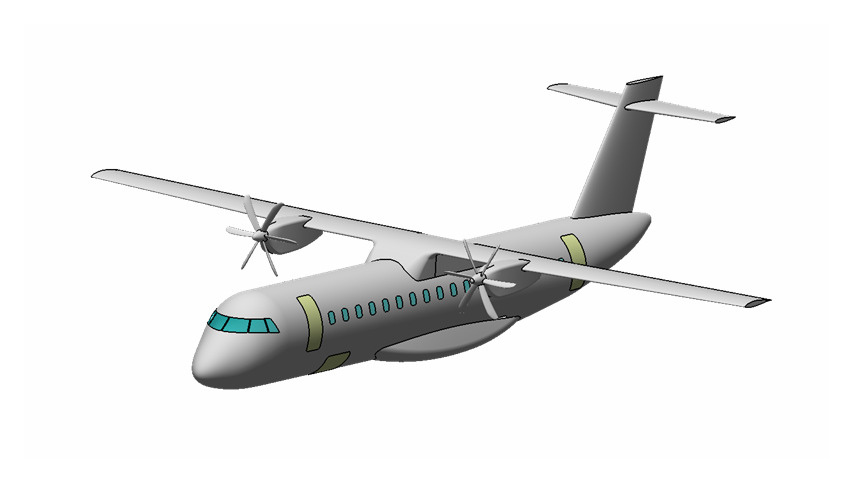
Feature picture is from Korea Institute of S&T Evaluation and Planning and shows a rendering from 2010 of a commercial turboprop it was considering developing.
한국항공우주산업(KAI)·인도네시아 PTDI, 중형 민항기 공동개발 모색
한국항공우주산업(KAI)과 인도네시아 국영 항공기 제조업체 PT 디르간타라 인도네시아(PTDI)가 중형 여객기 협력을 모색하고 있다. 이에 따라 독자적인 상용 터보프롭 항공기를 개발하려는 한국의 오랜 숙원이 되살아날 가능성이 있다.
민항기 협약은 KAI와 PTDI가 11월 11일 자카르타에서 체결한 양해각서(MoU) 3건 가운데 하나다. 나머지 2건은 방산 분야다.
민항기 MoU에 따라 양사는 시장 분석, 기술, 설계에 관한 정보를 교환하고 협력 가능성을 모색한다. KAI는 이번 협력이 세계적으로 늘고 있는 중형 여객기 수요에 대응하기 위한 것이라고 설명했다. 양사 모두 좌석 수, 설계, 예산, 일정은 밝히지 않았다.
김종출 KAI 대표이사는 “중형 민항기 개발 협력으로 논의를 확대해 인도네시아와 함께 글로벌 항공우주 시장에서 새로운 성장동력을 창출하겠다”고 말했다.
PTDI는 양사가 시장, 기술, 기체 설계 연구를 포함해 차세대 중형 상용 여객기의 공동개발 가능성을 검토하고 있다고 밝혔다.
같은 날 PTDI는 한국항공서비스(KAEMS)와도 MoU를 체결했다. 이 MoU는 해양경찰청과 대한민국 공군이 운용하는 CN235 및 C212 항공기의 정비·수리·분해점검(MRO) 지원을 다룬다.
인도네시아는 터보프롭 항공기를 개발하고 인증한 경험을 갖춘 극소수 아시아 국가 중 하나다. 또한 인도네시아는 세계 최대의 상용 터보프롭 시장이다. 한국은 터보프롭 항공기나 초경량 제트기로만 취항할 수 있는 신규 도서 공항이 개발되면서 상용 터보프롭 항공기의 신흥 시장으로 떠오르고 있다.
분석 및 배경
이번 민항기 MoU는 초기 단계의 연구로, 신규 기종 개발 착수를 의미하지는 않는다. KAI와 PTDI 모두 중형 항공기가 터보프롭기인지 제트기인지 밝히지 않았으며, 좌석 수, 설계, 일정도 공개하지 않았다.
한국은 과거 두 유형의 중형 여객기를 모두 검토한 바 있다.
첫 번째 주요 시도는 제트기였으며, KAI 설립 이전의 일이다. 1990년대 중반 대우중공업, 대한항공, 삼성항공 등이 참여한 한국중형항공기사업조합은 중국항공공업총공사와 100인승 리저널 제트기 개발을 협상했다.
이 협상은 중국이 상하이에서의 최종 조립을 고집하고 한국 측에 약 10~12.5%의 지분만 제시하면서 1996년 6월 베이징에서 결렬됐다. 이후 1999년 대우, 삼성, 현대의 항공우주 부문이 통합돼 KAI가 출범했다.
한국 리저널 여객기에 관한 가장 상세한 정부 연구는 터보프롭기를 대상으로 했다. 2010년 한국과학기술기획평가원(KISTEP)은 ‘차세대 중형항공기 개발사업’에 대한 예비타당성 조사 결과를 발표했다.
이 조사는 KAI, 대한항공, 한국항공우주연구원을 설계팀으로 제시했다. 조사 대상은 88인승 기본형 DRA88과 72인승 파생형 DRA72로 구성된 리저널 터보프롭 기종군이었다.
KISTEP은 총 개발비를 20억 달러로 추산했으며, 이 중 한국 측 부담액은 1조1천억 원(8억2천300만 달러)이었다. KISTEP은 조건부로 사업 추진이 타당하다고 판단했고, 정부는 2011년 예산에 국제공동개발 명목으로 110억 원(820만 달러)을 편성했다.
그러나 지속적인 해외 협력사를 확보하지 못하면서 사업은 정체됐다. 2013년 10월 국내 언론은 봄바디어가 90인승 터보프롭 협상에서 발을 뺐다고 보도했다.
중앙일보에 따르면, 국회예산정책처는 이후 이 사업의 해외 협력이 세 차례 중단돼 4년간 386억 원(2천890만 달러)이 집행되지 않았다고 지적했다.
KAI는 그 후에도 여객기 개발을 계속 검토했으며, 터보프롭기에만 국한하지 않았다. 2016년 1월 KAI 관계자는 코리아타임스에 PTDI와 “민간 제트여객기 개발”을 논의할 것이라고 밝혔다. 당시 하성용 대표이사는 KAI가 100인승 여객기 개발을 목표로 하고 있다고 말했다.
2019년 1월 당시 김조원 대표이사는 KAI가 100석 미만 항공기의 면허생산을 검토하고 있다고 밝혔다. 국내 언론은 KAI가 봄바디어와 Q400 터보프롭기 면허생산을 협의 중이며, 50~70인승 독자 항공기 개발도 검토하고 있다고 보도했다.
Korea's KAI And Indonesia's PTDI Explore Mid-Size Civil Aircraft


